Advanced 3D Printing
On Tuesday, specialists at the Vienna University of Technology (TU Vienna) advertised another 3D printing innovation fit for of making complicatedly itemized structures at the nanometer scale with remarkable speed.
The technique, called two-photon lithography (TPL), works by following a finely centered laser bar through a pool of resin. As the beam’s focal focus—simply two photons wide—beats into the fluid, the resin solidifies on that focus and deserts an unyielding structure. As an exhibit of the printer’s abilities, specialists printed a 285-micrometer-long Indycar reproduction. It’s simply more substantial than a couple strands of hair.
Granted that elevated resolution has consistently been a major ability of TPL, as items are printed nanometers around then, speed has not. Past innovations, for example the one German research organization Laser Zentrum Hannover improved, walked in at a rate of millimeters for each second. As per Torgersen, his crew’s system can print at rates of meters for each second, which ends up as a thousand fold expand.
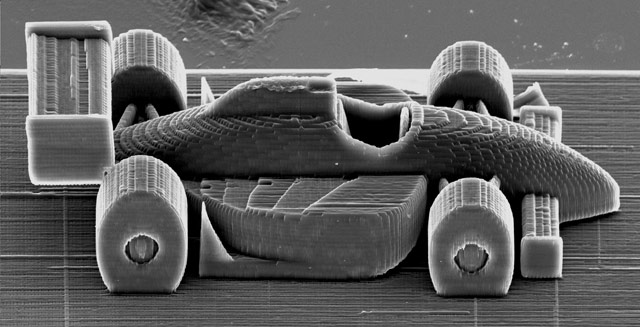
This speed expands hails from the advancement of a purposeful, snappy-responding pitch, and a framework of tuned mirrors that guide the laser pulses through the fluid. Past TPL setups utilized a criticism framework to control the mirrors that could check to verify the gum had solidified and that the mirrors were legitimately straightened before shooting every beat. Torgersen’s group alternately utilized a preprogrammed set of deferrals, which kept the mirrors in reliable movement, expanding the beat speed and in this way the printing speed. It wasn’t basic: Without criticism control, analysts needed to fine-tune the postponements between the developments of the mirrors while guaranteeing that the laser beats might keep up.


